

ROADMAP
Introduction
The ISLANDR Roadmap is a practical framework that helps stakeholders organize the transformation of contaminated sites.
Purpose
Guidance, Not Prescription
Adaptable
Objective
The ISLANDR Roadmap aims to support practitioners involved in remediation and redevelopment by leveraging ISLANDR outcomes to add value.
Added Value: Building Blocks
- Dark green boxes - " linked to the activities of the journey from site identification to maintenance.
- Light green boxes - " additional Building Blocks derived from other projects.
Focus Areas
- Soil health
- Spatial planning
- Low-input remediation
- Wider benefits
This approach helps strengthen policy and investment cases for the sustainable, risk-based management of "B" and "C" type sites and diffuse contamination.
Site Classification: ABC Model
- Type A - " Strong financial feasibility driving redevelopment, e.g., high property value.
- Type B - " Marginal private sector financial case; redevelopment could be facilitated by public funding intervention, such as an investment fund.
- Type C - " No direct viable financial case for redevelopment.
Users and Journeys
Potential user groups involved in remediation and redevelopment, the roadmap might support include:
Their needs have been considered while developing the roadmap, so three distinct journeys or management pathways were proposed based on the type of site and contamination faced.
Journey 1: Single Site
This journey considers remediation / redevelopment / restoration of a single site, that may be contaminated. This single site journey focuses on:
- understanding the level of contamination
- exploring different remediation and redevelopment strategies
These strategies contribute to building the business case for the actual remediation and redevelopment of the site.
Roadmap Journey 1: Single Site
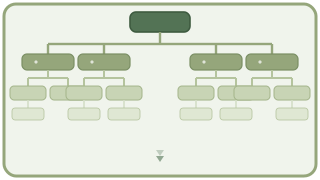
Overview of Activities per Phase
Identification Phase
- Prioritisation of inventoried sites (Top-down approach)
- Land redevelopment as a trigger (Bottom-up approach)
- Suspicion of contamination
Vision / Initiative Phase
- Preliminary site investigation
- Qualitative (preliminary) risk assessment
- Preliminary business case
- Communication and dissemination strategies
Planning Phase
- Exploration of a strategy
- Comprehensive site investigation [EM6.1]
- Quantitative (detailed) risk assessment
- Remediation and re-use strategies
- Remediation planning
- Redevelopment and restoration plan
- Environmental and social impact assessment (ESIA)
- Business case
- Communication and dissemination strategies
Realisation Phase
- Procurement, contracting, permits, and permissions
- Remediation implementation
- Restoration implementation
- Redevelopment implementation
Control Phase
- Interaction and communication with relevant stakeholders
Maintenance Phase
- Operation and maintenance activities based on the plan
- Competent authorities check compliance with remediation objectives
- Interaction and communication with the broader community
Journey 2: Portfolio of Sites
This journey considers a portfolio of sites owned by public or private organisations or by those involved in the privatisation of public sites.
Regional / NationalIt focuses on:
- prioritising sites
- finding synergies to maximise monetary and sustainability gains
For example: Private sites (A sites) can finance the redevelopment and remediation of public-private or fully public sites (B and C sites). See explanation of A, B and C sites in the objectives.
Journey 3: Diffuse Contamination
This journey considers areas with potential diffuse soil contamination.
Regional / NationalThe ISLANDR project defined diffuse soil contamination as a type of soil contamination that:
- covers large areas
- is not necessarily caused by a single contaminant
- can be spread via several media to the environment
- is typically not originating from a single source or limited to certain industry
Roadmap Components
The roadmap integrates three components:
- Phases of the soil remediation process represented by the yellow colour
- Activities that should take place during each phase
- Building blocks that can support the conduction of those activities
Phases
Identification
The Identification phase marks the initial stage of the ISLANDR Roadmap, where potentially contaminated land areas are identified. This can occur through various pathways, including:
- a strategic inventory process that assesses past site uses
- sites entering a spatial planning process with former potential contaminative use
- sites with a regulatory demand
- site reviews triggered by events like divestment, mergers, or acquisitions
Additionally, site-specific triggers- "such as planned redevelopment, changes in land use, regulatory scrutiny, or external concerns like community complaints or whistleblowing- "can also lead to contamination concerns being flagged.
This phase sets the foundation for further investigation and decision-making in the remediation process.
Initiative / Vision
The Initiative or Vision phase begins with an actor who has an idea of a particular purpose for a site, for example: housing, business, public amenity, nature, or a combined purpose.
The key outcomes of this phase are an initial project champion(s) and an initial vision for a site. The vision may include a range of future uses, from simply an idea and its proponent(s) to a more detailed briefing of the vision and pathway by which it might be reached.
In some cases, the use(s) may be interim, which can support a period of soil health recovery (e.g., photovoltaic electricity in parallel with a nature-based solution). Another form of interim re-use might be linking a long-term treatment opportunity (such as phytoremediation) with interim use- "providing bio feedstock, natural habitat, social amenities via public access, or all three.
Planning
The planning phase is the process by which the vision is elaborated to arrive at detailed action plans. This includes:
- master planning, including definition of land uses
- investment and business planning
- obtaining necessary permissions from regulators, planners and other authorities
These may include spatial planning conditions and permits, process permits, waste permits, verification requirements, and institutional controls.
The planning phase also includes procurement of service providers, allocation of responsibilities, costs, returns and ownerships (freehold, lease, etc.), financial risks and liabilities, and community and user engagement.
A range of site management activities takes place during this phase, including: site investigation, risk assessment, risk management planning, remedy selection, remedial design, and verification planning.
Realisation
During this implementation phase:
- contracts are let
- practical delivery activities take place on-site
- specific regulatory permissions are agreed upon
The endpoint is the delivery of the vision foreseen in the master planning. Remediation activities fall within this phase- "sometimes in their entirety, including verification (for example, an in situ chemical oxidation treatment), or their establishment (for example, a pump and treat system or a phytoremediation).
Maintenance
The scope of maintenance depends on the site context. In some cases, where risk management has been completed, the primary maintenance activity might be institutional control, where the record of site use and risk management is maintained by a planning authority.
There will also be ongoing monitoring and verification tasks for longer-term treatments such as natural attenuation, containment, and phytoremediation.
For combined re-use and remediation, there may be a variety of business, sustainability information and monitoring collected, for example related to site re-use. This phase also encompasses stewardship activities, for example related to the gradual improvement of soil health.
ISLANDR General Building Blocks
There are specific building blocks to support the implementation of several activities, plus a cross-cutting building block related to data management.
Building Block IB1 - Guidelines for FAIR Data
ISLANDR provides recommendations in a Roadmap for EUSO-compatible data to make data on diffuse and local soil contamination: Findable, Accessible, Interoperable, and Reusable (FAIR).
Key points:
- Focuses on linking data in the ISLANDR metadata catalogue with newly gathered data to fill data gaps.
- Ensures data interoperability by following international standards for both data and metadata.
Read more: Roadmap to EUSO compatible data [Link to deliverable 1.4]
Building Block IB2 - Key Terminology
To advance standardised data interoperability, harmonising terminology is crucial, for example for soil datasets and risk-based land management.
Key points:
- Soil vocabularies come from many national and international sources.
- Harmonised terminology ensures reliable comparison and avoids misinformed decisions.
- ISLANDR collected existing soil-related vocabularies and proposed an organized list of terms with definitions.
More information: Appendix 1, Appendix 2, ISLANDR Deliverable D1.3 Ontology [Link to deliverable 1.3]
Building Block IB3 - Overview of Local Soil Contamination Databases & Other
Data Sources
Supports planning and implementation of registers/databases suggested in the Soil Monitoring Directive.
Key points:
- Many national and regional authorities have systematically identified sites with suspected soil contamination.
- Local soil contamination databases are used for prioritising investigation and remediation actions.
- Some databases include priority classifications.
- National and regional databases feed into European-wide indicators, which can later contribute to national soil contamination registers as proposed in the Soil Monitoring Law.
- ISLANDR provides a metadata catalogue of local (and diffuse) soil contamination databases in Europe.
More information: ISLANDR Deliverable D1.1, ISLANDR Metadata Catalogue [Links]